Site Agreement & Land Access
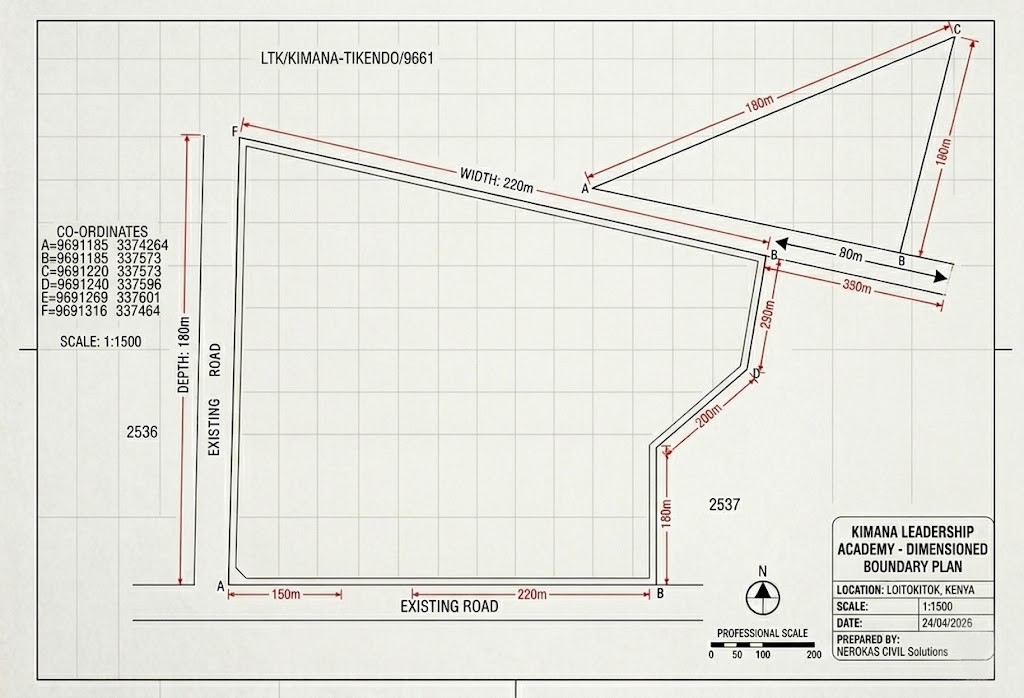
CompleteThe school director of Bendera Primary School (Kimana, Kenya) formally offered 2 acres of school land for the full Maa Sovereign hub build-out. This includes space for the BSF shed, Love Cage, duckweed/azolla lagoons, sovereignty garden, and future poultry units.
- ✓ Site visit completed
- ✓ Director agreement in place
- ✓ Land demarcated — 2 acres confirmed
- ✓ 250-student cohort confirmed as research base
BSF Shed Construction — 6 × 4 m
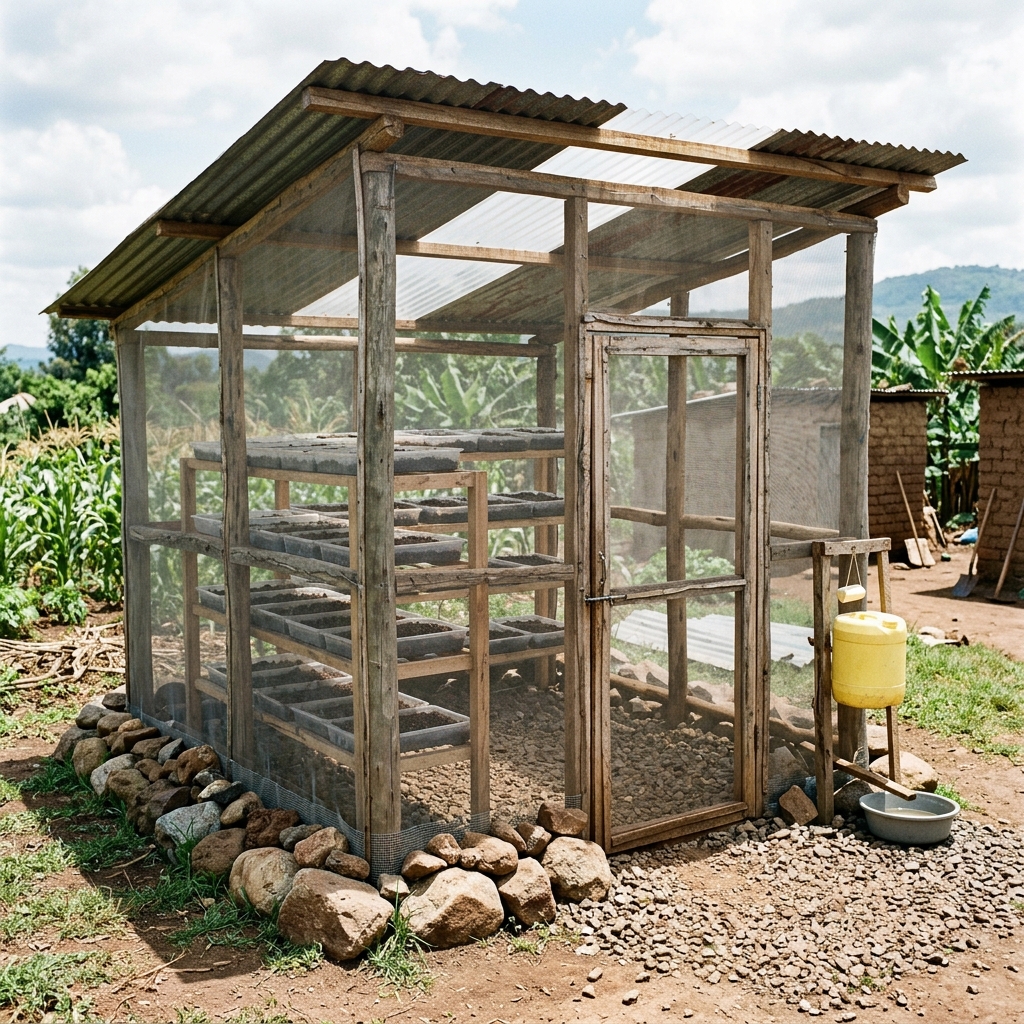
In ProgressThe first physical structure being built on site is the 6 × 4 m BSF shed. This will house the Black Soldier Fly bioconversion system — the core engine of the circular value chain. The shed provides controlled temperature, humidity, and light conditions required for the complete BSF life cycle.
BSF larval protein, combined with duckweed and azolla biomass, will feed the pilot poultry unit — target 500 to 1,000 laying hens. At scale, the hen flock produces eggs for daily student nutrition and generates revenue that makes the hub self-sustaining without external subsidy.
- ✓ Foundation layout marked
- ✓ Materials sourced locally
- ⟳ Framing and roofing — in progress
- ○ Internal partitions + Love Cage area
- ○ Ventilation system
- ○ ESP32 sensor mounting points
- ○ Poultry shed — Phase 1b (follows BSF shed)
photos — add here
photos — add here
photos — add here
Love Cage — BSF Mating Enclosure
UpcomingThe Love Cage is the enclosed mating chamber where adult Black Soldier Flies mate and lay eggs. Without a controlled mating environment, the colony cannot self-sustain. This is the biological heart of the system — guaranteeing a continuous cycle of larvae without purchasing new stock.
Adult flies require: natural light, sheltered airflow, vegetation for perching, and a substrate for oviposition (egg laying). The Love Cage design uses a mesh-covered bamboo or timber frame, positioned inside the BSF shed near the natural light source.
- ○ Frame design finalised
- ○ Mesh and fixings sourced
- ○ Oviposition substrate installed
- ○ First colony seeded
- ○ Arduino temp + humidity sensors mounted
photos — add here
photos — add here
photos — add here
Duckweed & Azolla Lagoons — 4 × (10 m × 2 m)
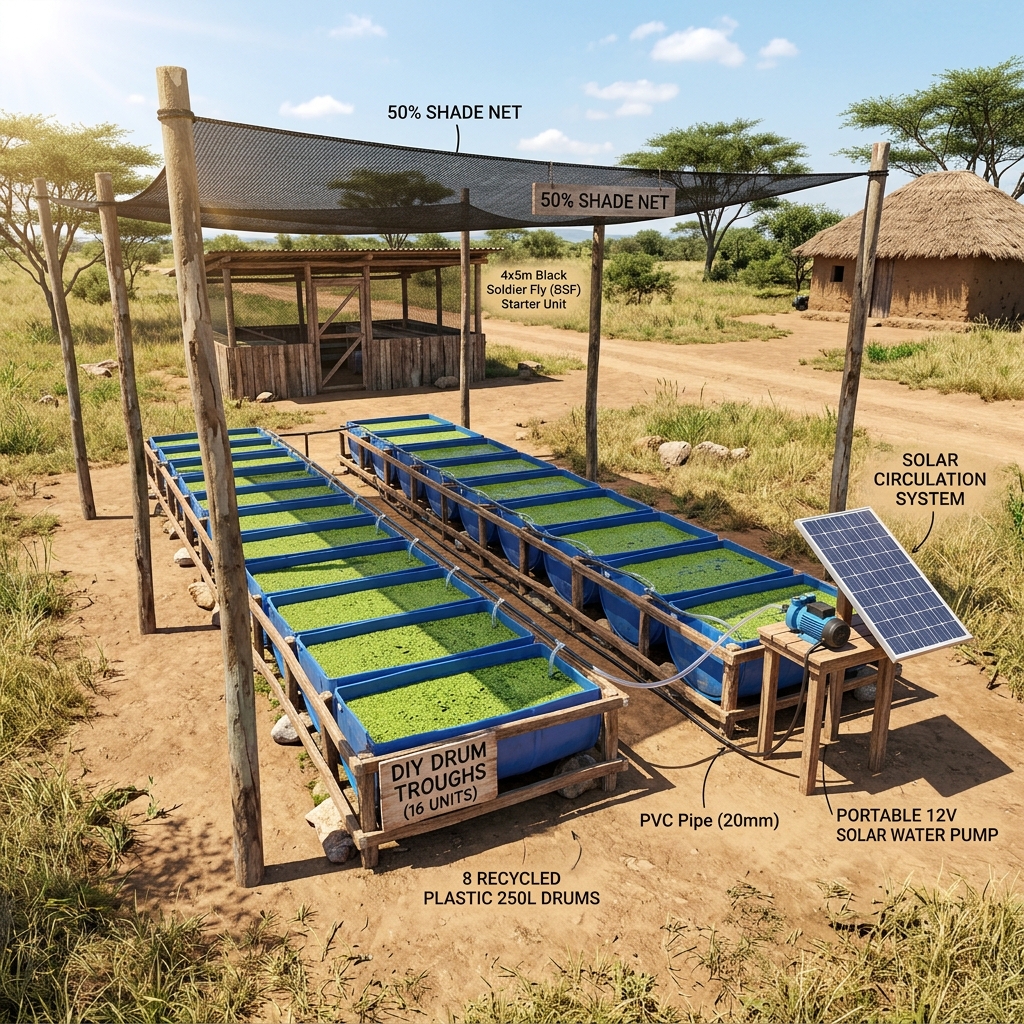
PlannedFour lagoon tanks measuring 10 m × 2 m each will cultivate Duckweed (Lemna minor) and Azolla — two of the world's fastest-growing plants, both rich in protein (30–45% crude protein dry weight).
Duckweed doubles its mass every 24–48 hours under optimal conditions and remediates nitrogen and phosphorus from wastewater. Azolla fixes atmospheric nitrogen, reducing the need for external fertiliser. Together they form a dual water-remediation and protein-production system.
Output feeds the BSF larvae and the poultry units. Excess frass from BSF returns as fertiliser to the sovereignty garden. Full closed loop.
- ○ Tank design finalised (4 × 10m × 2m)
- ○ Liner and frame sourced
- ○ First Duckweed culture inoculated
- ○ First Azolla culture inoculated
- ○ pH + temperature sensors (Arduino) installed
- ○ Water inlet + outlet gravity system
photos — add here
inoculation — add here
ESP32 Bio-Monitoring Station & API
In Progress — Components OrderedThe hub's autonomous data collection runs on an ESP32 DevKit V1 — a microcontroller with built-in WiFi and Bluetooth, sealed inside an IP65 waterproof enclosure rated for the high-humidity, high-fly-density environment of the BSF shed. No manual data entry. Machines record the numbers.
The station logs 7 data streams continuously, transmits live via WiFi to the Maa Sovereign cloud platform, and maintains a local SD Card "Black Box" backup for offline resilience. Power is fully off-grid: solar panel on the shed roof, 18650 lithium cells, TP4056 solar charging controller. Target: 24/7 autonomous operation.
As a STEM pilot, the students themselves will participate in final assembly under technical guidance — making the station both a data tool and a living classroom.
- ✓ Hardware manifest finalised
- ⟳ Quotation requested from supplier (Nairobi)
- ○ Components received
- ○ Station assembled (students + technician)
- ○ First sensor readings logged
- ○ WiFi uplink — data to cloud pipeline
- ○ API endpoint live for partners
photos — add here
reading — add here
photos — add here
First Full Biological Cycle
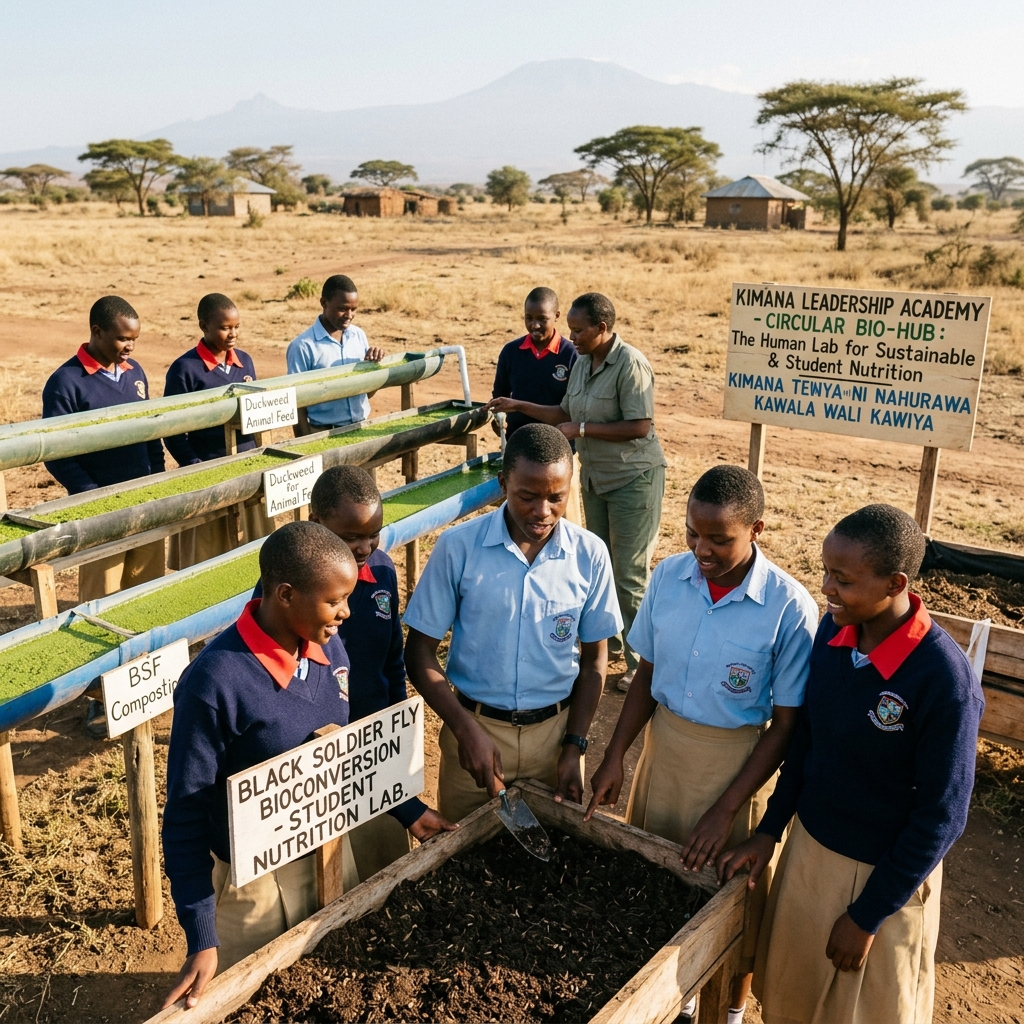
PlannedThe first complete biological cycle confirms the system works end-to-end: organic waste in → larvae → protein → school nutrition → IoT data out. This is the moment the PoC becomes a proven model.
- ○ First waste batch loaded into BSF bed
- ○ Larvae emergence confirmed
- ○ Harvest cycle completed (14 days)
- ○ Duckweed harvested and weighed
- ○ First eggs produced and distributed to students
- ○ IoT data recorded — first clean dataset
- ○ Carbon baseline established
photos — add here
to students — add here